

If you sell resources on Teachers Pay Teachers, you have probably seen the recent announcement about changes to its seller program. Beginning in 2027, TPT is replacing its Premium Seller membership with a new Exclusive Seller option. Sellers who choose Exclusive status will receive a higher payout rate and additional seller tools, but qualifying digital educational resources must be sold exclusively through TPT. Sellers who want to sell those resources elsewhere can remain or become Basic Sellers instead.
That is a meaningful change for teacher-sellers, especially those who have spent years building catalogs, earning reviews, growing followings, and depending on marketplace income.
I want to be clear about something from the beginning: this is not an argument that TPT is bad or that every seller should leave. TPT offers something genuinely valuable. Teachers are already there looking for resources, buyers trust the marketplace, and the platform handles much of the infrastructure that independent sellers would otherwise have to manage themselves.
For some sellers, the new Exclusive program may be the right choice. For others, remaining Basic and keeping the ability to sell elsewhere may make more sense. And some sellers may have no interest in processing their own sales at all.
But I do think this moment raises a larger question:
How much of your business do you actually own?
When your entire business lives inside a marketplace, you are also building it inside someone else’s system. That platform controls the fees, search algorithm, features, seller requirements, and business model. That is not inherently sinister. Every company gets to decide how its platform operates.
But you get to decide how much of your business depends on those decisions.
That is why I have always believed in owning your own online home.
I started teaching myself how to build websites in 2002, long before I became a classroom teacher. Later, when I began creating resources for English teachers, I combined those two parts of my life. Instead of building my educational publishing business entirely inside someone else’s marketplace, I built my own website.
Over time, reThink ELA grew into an independent educational publishing business with digital resources, memberships, paid content, articles, email marketing, and a growing body of work that teachers can find through search. I have used WordPress, membership software, ecommerce tools, payment processors, email systems, and all the other moving parts that come with running a digital business independently.
That does not mean running your own site is easier.
When you own the website, you also inherit more responsibility. You have to think about hosting, backups, security, payment processing, file delivery, customer accounts, refunds, taxes, and customer support.
But you gain something important in return: a place where your brand, content, search traffic, audience, and body of work can grow over time.
And your website does not have to replace TPT to be useful.
TPT’s new rules still allow Exclusive Sellers to maintain their own websites and use them to promote qualifying resources, as long as those purchases ultimately go through TPT. A website can also support other parts of the business: your blog, email list, professional development, courses, services, free resources, and other products allowed under TPT’s rules.
So this is not necessarily an either/or decision.
Your TPT store can remain one place where teachers discover and buy your work. Your website can become the place where they learn who you are, read your ideas, discover everything else you offer, and choose whether they want to stay connected with you.
That is also where the larger issue of sustainability comes in.
A strong digital business is not just a collection of products sitting on a website. It needs a way for the right people to find you, a way for them to understand what you offer, a way for them to stay connected, and a way for your work to continue creating value over time.
That might include search traffic, useful articles, an email list, free resources, memberships, courses, professional development, consulting, or direct sales. You do not need all of those things. You do need a business model that is not entirely dependent on one source of traffic or one platform making the same decisions forever.
That is the reason I substantially rewrote an old guide I originally created for teachers who wanted to start businesses.
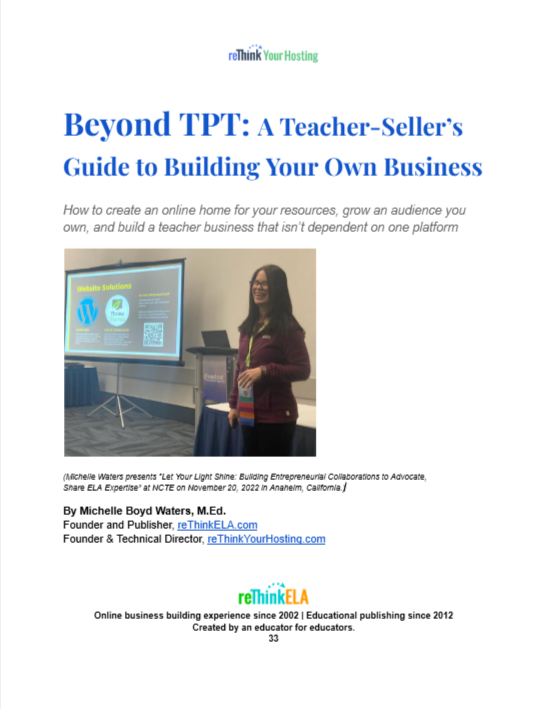
The new version is called Beyond TPT: A Teacher-Seller’s Guide to Building Your Own Business.
The guide walks through the practical questions teacher-sellers are asking right now: whether you actually need a website, how your website can work alongside TPT, what you need to build first, how to choose a domain and hosting, why I still recommend WordPress, which pages your first site actually needs, how an email list fits into a sustainable digital business, and what changes if you decide to sell directly.
I also included a 30-Day Teacher-Seller Website Plan and an updated 10-Step DIY Teacher Website Checklist so you can build the foundation gradually instead of trying to create an entire business infrastructure in one weekend.
Remember, your goal is not to build the biggest website you can; it is to build the smallest useful foundation that gives your business somewhere to grow. Like I tell my students: An ugly first draft is better than a blank piece of paper. A tiny online storefront that’s yours is better than nothing.
You do not need to upload your entire catalog right away. You do not need to become a web designer. You do not need to understand every part of WordPress before you publish something.
You just need to start building assets you control: your domain, your website, your content, your audience, and your brand.
Then you can decide what comes next.
You may eventually sell independently. You may keep sending buyers to TPT. You may add a course, membership, consulting, or professional development. You may discover an entirely different revenue stream five years from now.
The point is not to predict exactly what your business will become: The point is to give it somewhere to grow.
So, if the recent TPT changes have you wondering whether it is time to build your own website, or if you have been meaning to do it for years and this was simply the push you needed, I created this guide for you.
Discover more from reThink Your Hosting
Subscribe to get the latest posts sent to your email.
0 comments